
How long will it take to get an independent board seat?


I am continually asked – How long will it take to get a seat on a board as an independent director. As you can imagine, this question is incredibly challenging to answer. There are many variables to consider, and everyone’s pathway to their first and subsequent independent board seat will differ. However, I can tell you that a board seat will not just fall in your lap. It is also unlikely to happen as a result of a one-off application or conversation. Adopting a persistent, focused approach is key to being appointed to a board seat in a shorter time frame.
Searching for an independent board seat is challenging and time-consuming. Maintaining the effort and ongoing enthusiasm required can sometimes feel unsustainable, with many becoming disgruntled. This leads them to stall the process for several months or even permanently. I advise my clients to make a 12-month, honest, and meticulous commitment to find their first independent board seat. If you follow my advice and processes, you will likely get appointed much earlier.
Is “How long will it take?” the right question to ask?
My answer is an unequivocal NO! Stop wasting your valuable time trying to answer a question that will likely set you up for unrealistic expectations. Instead, I recommend asking yourself these three more practical questions:
- Which organizations are likely to appoint me?
- What do I have to offer a board?
- How much time do I have to dedicate to the process?
By addressing my 3 pillars to gaining a board seat, you will answer these three questions and provide yourself with the framework, process, and tools to get appointed.
The 3 Pillars to gaining an Independent Board Seat
For nearly two decades, I have specialized in working with aspiring and experienced directors to secure board appointments. During that time, I have spoken to hundreds of board chairs and successful board directors. What became clear to me was that there are three fundamental pillars that lead to a successful board appointment.
These 3 pillars are ASPIRATION, ARTICULATION & APPLICATION. If you are not successful in gaining an independent board seat within 12 months, you are likely doing at least one of three things wrong.
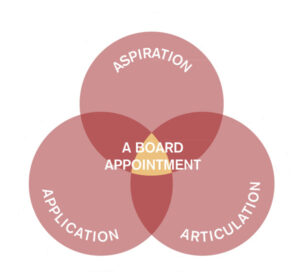
ASPIRATION: Defining realistic board targets
Identifying the type of organization you want to join is an essential first element. Although it may seem straightforward, many aspiring board directors struggle to confidently answer, “What boards do you want to sit on?” Instead, they often provide a generic or vague response that spans various business types and industries. This stems from a lack of clearly defined board aspirations.
Once you start talking to people about pursuing a board seat, I can assure you that “What boards do you want to sit on?” is one of the most common questions you will be asked. Providing lackluster responses will lead them to view you as disorganized and opportunistic. Leaving them no other option but to dismiss your board aspiration. Not the outcome you want, given that 65% of people are directly appointed to a board through a personal or professional connection.
The second element of the aspiration pillar is ensuring your board aspirations are realistic and achievable. For example, you are unlikely to be appointed as an independent director of the Amazon board without extensive experience in senior executive roles, governance, corporate boards, retail, technology, and/or logistics.
ARTICULATION: Why YOU should be appointed to an independent board seat
Most aspiring directors will have several reasons for seeking an independent board seat or portfolio career. Some of these reasons will be driven by personal ambitions, while others will be driven by external motivations. While personal ambitions drive your interest, some motivations resonate more with stakeholders than others. Mastering the ‘Articulation’ pillar requires you to distinguish between these inward drivers and the outward value you provide, ensuring your pitch aligns perfectly with the board’s strategic needs.
The second aspect of articulating is expressing your value at the board level. You must consider what organizations want in successful board candidates and clearly articulate what you have to offer. You need to be able to do this formally, informally, verbally, and on paper. These statements should be incorporated into your board profile and pitch.
I strongly recommend writing or revising your Board CV as a starting point. This process does more than create a document; it forces you to synthesize your experience and refine the specific value you offer at the board level. Once established, use this clarity as the foundation for both your formal board profile and your informal elevator pitch.
APPLICATION: How to make it happen
Perserverance is the key to the Application pillar. Like many things, the harder you work, the more likely you are to succeed. However, when it comes to gaining a board seat, working strategically is as imperative as working with commitment. You need to determine where best to devote your efforts. That means considering the four ways board appointments are made:
- Through personal connections,
- By directly approaching an organization;
- Via a Recruiter;
- Responding to an advertised board opportunity.
Navigating these pathways effectively is key to determining how long it will take to get a board seat. While recruiters and advertisements follow a rigid, formal timeline, the ‘hidden’ market of personal connections and direct approaches is more fluid. Mastering both the formal and informal strategies ensures you are not waiting on a single channel to deliver results.
So, how long will it take to get an independent board seat?
Well, that depends; the smarter you work, the faster this will happen. You need to clarify which organization you want and are eligible to be appointed to. You need to be able to articulate what you can offer a board. You need to be willing to consistently put in the time and effort required. If you can answer ‘yes’ to these questions, you should expect an independent board seat within 12 months.
Identifying your target organizations is a complex process and, if not done effectively, will impact everything moving forward, including how long it will take to experience success. Articulating your board profile and pitch is challenging. Applying yourself to the various pathways to an independent board seat requires aptitude and perseverance. During the extensive training included in my Board Appointment Program, I will take you through all these elements step by step.
Related Articles
An Independent Board Director: 6 tips to get started





Responses